
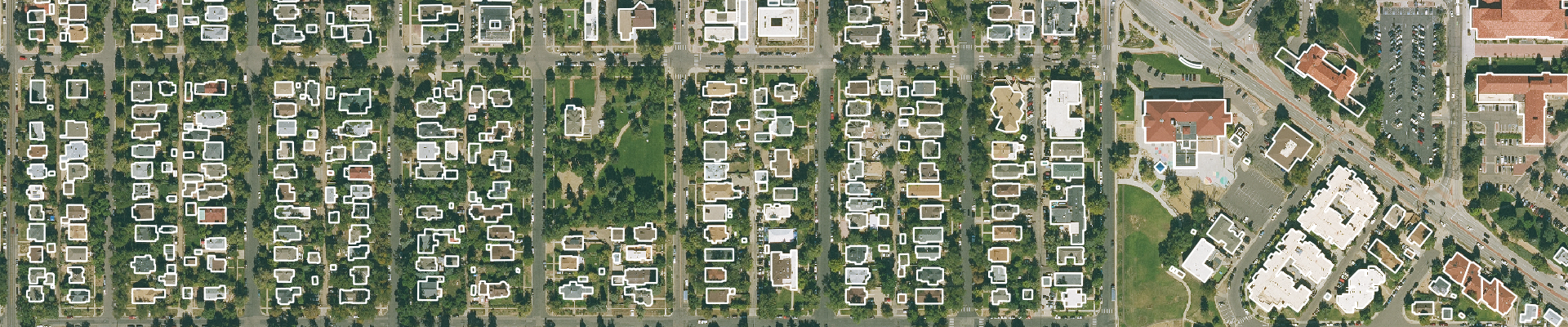
EarthDefine Building Footprints 3D
- 191M+ properties mapped
- Heights & elevations
- Available off-the-shelf
Rapid Updates
Always current on imagery and LiDAR. Our AI processes millions of buildings monthly so you're never working with outdated data.
Accuracy
Make confident decisions with detailed roof outlines at over 98% accuracy.
Addresses
Connect every building to a street address for seamless integration with your workflows.
3D data
Access building heights, estimated stories, and volume for 151M+ structures. Get in touch to learn more.
How industry leaders use building footprints
The Building Footprints 3D product provides GIS-ready building data to support a host of mapping and spatial analysis functions. Example applications include:
- Broadband mapping: Accurately map and report fixed and mobile broadband coverage with unprecedented granularity.
- Improved geocoding: Go beyond street level or parcel centroid based geocoding solutions to accurate building rooftop based locations.
- Enhanced mobile marketing: Target your customers better based on their proximity to a building geofence.
- Improved insurance underwriting: Use distance to buildings locations to understand and model property risk from floods, landslides, fire, utility lines, trees etc.
- 5G planning: Create accurate models with 3D buildings for RF simulation.
- City planning: Understand urban growth, map heat islands, conduct line of sight analysis, generate 3D building models etc.
- Change analysis: Map buildings across different years to enable detailed insights into residential and commercial construction activity across time.
- Building monitoring: Find and map unapproved structures by comparing building permit data to ground structures.
- Population mapping: Use dasymmetric mapping with building footprints to map and visualize demographic data precisely across regions.
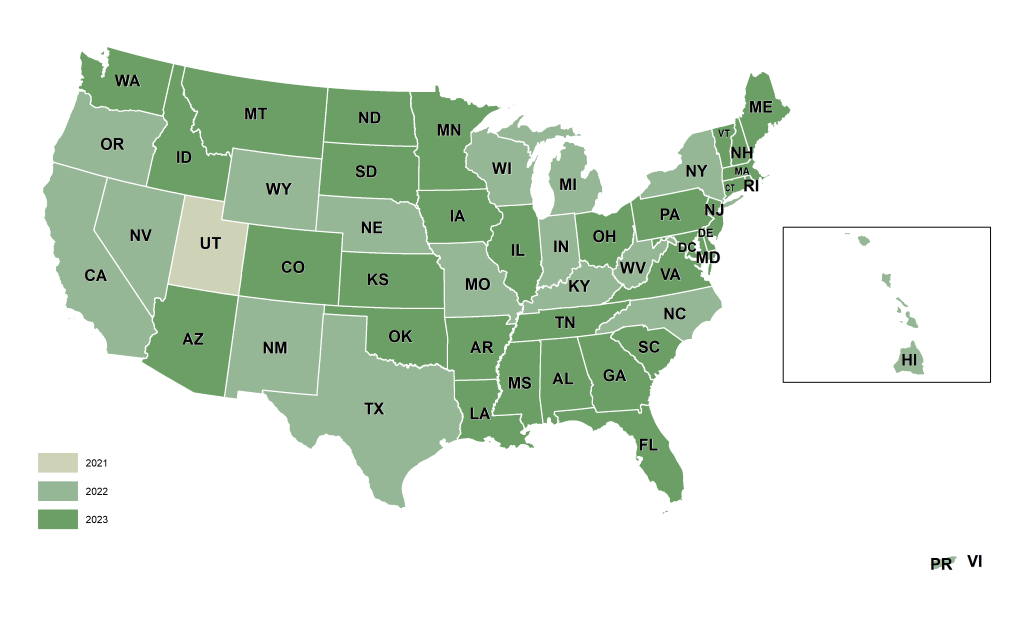
Data coverage and freshness
| Technical Specifications | |
|---|---|
| Source | High-resolution Imagery/Lidar |
| Dates | 2021-2023 |
| Accuracy | >98% |
Download and Evaluate
Looking for samples for a specific region?
Our data experts can generate a sample for your region of interest.
Request DataFrequently Asked Questions
The majority of the buildings are classified from the USDA (United States Department of Agriculture) NAIP (National Agricultural Imagery Program) imagery, which is supplemented by publicly available LiDAR (Light Detection And Ranging) data where available.
The NAIP imagery is a mix of 30-60cm spatial resolution, and has been georectified by the USDA to be +/- 6 m with a 95% confidence level (CE95).
The buildings are classified from the imagery using state-of-the-art Deep Learning algorithms. Once classified, the buildings are converted to vector format, regularized (squared up), split by parcel boundaries, addressed, and merged statewide.
The buildings are over 98% accurate on a pixel-by-pixel basis using validation data from dozens of urban areas across the country. In terms of Intersection over Union (IoU), a metric that assesses the agreement between predicted and control buildings, the accuracy is over 94%.
Since the NAIP imagery is flown on a state-by-state basis, the buildings are updated whenever new imagery becomes available. Most states fund NAIP every other year, so a nationwide refresh occurs every two years. We also update our buildings when we significantly improve our AI or make changes to our post-classification processing. We update our buildings quarterly, but the most significant change occurs when new imagery or LiDAR becomes available.
Other than a lag in available NAIP imagery, some areas still have older data because NAIP imagery isn't available, or hasn't been updated. Military bases and other sensitive areas are examples of places where older NAIP hasn't been authorized for public use, and are thus filled with the latest publicly available data. Occasionally, NAIP imagery does not meet EarthDefine's quality standards or is of lower quality than the previous year's imagery. In these cases, older imagery may be used to derive higher quality footprints.
Both the str_UUID and bld_UUID fields are preserved between updates, however shifts in data or changes in building size will often cause new UUIDs to be implemented.
As of yet, we do not track when new buildings appear nor do we track how buildings change over time. The date associated with the building in our product refers to the year of the imagery the building was mapped from, not when the building appeared or changed.